
Geometry compasses are essential tools used for drawing circles, arcs, and angles in various technical fields, including mathematics, engineering, architecture, and design. These instruments are indispensable for tasks that require precision and accuracy in measurements and constructions. There are various types of geometry compasses available, each designed for specific uses and offering different features.
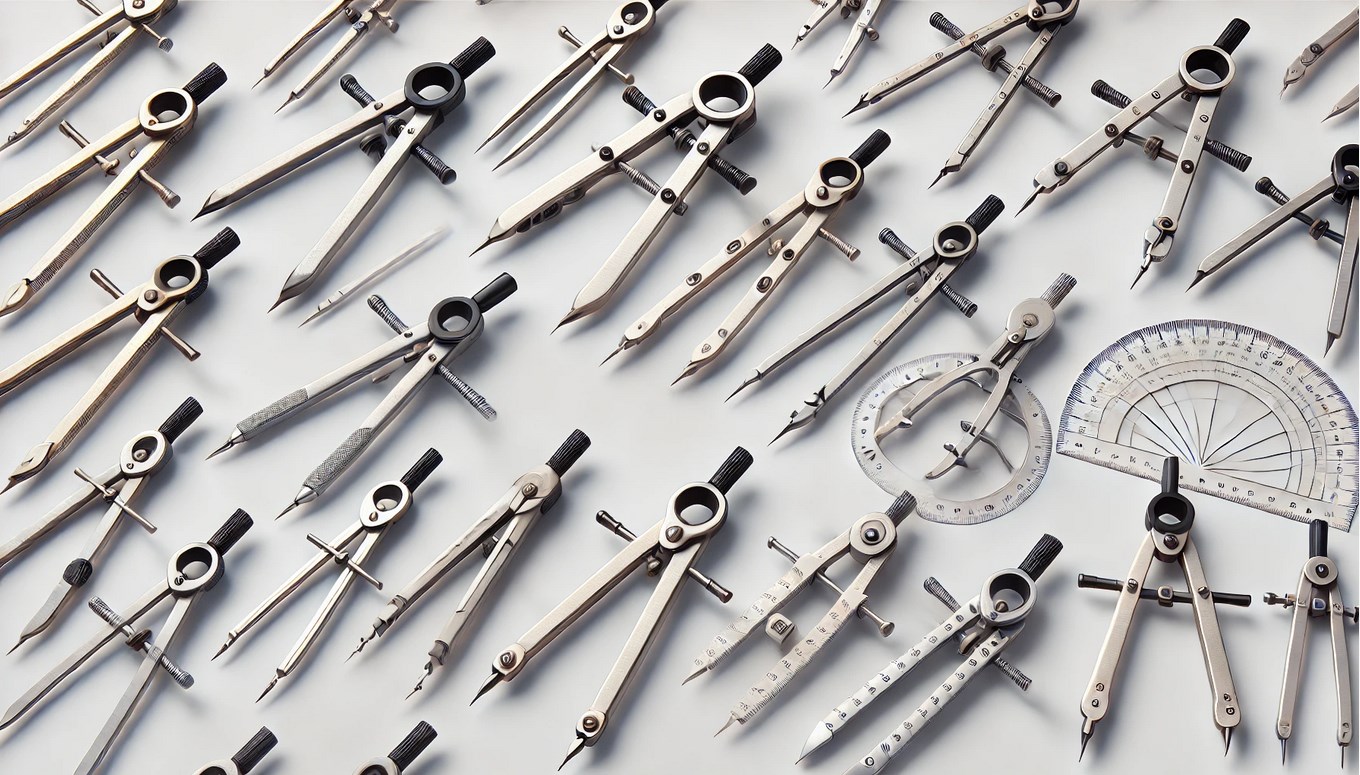
Standard Geometry Compass
The standard geometry compass is the most common type used in schools and educational settings. This compass is typically used for basic geometric constructions such as drawing circles, arcs, and bisecting angles. It consists of two arms: one with a pointed end for anchoring and another with a pencil or pen to draw the circle.
Features of Standard Geometry Compass:
- Simple Design: The compass has a basic structure with two adjustable arms, making it easy to use for drawing circles and arcs of varying sizes.
- Adjustable Radius: The compass allows users to set and adjust the radius of the circle by changing the distance between the pointed arm and the pencil arm.
Standard geometry compasses are typically used by students, artists, and professionals for general geometric tasks such as drafting and sketching. They are a staple in classrooms and are often used for introductory lessons on geometric shapes and constructions.
Precision Compass
Precision compasses are designed for tasks that require a high level of accuracy and fine adjustments. These compasses are commonly used in professional settings like engineering, architecture, and technical drawing. They are typically made of high-quality materials like steel or aluminum to ensure durability and stability during use.
Features of Precision Compass:
- Fine Adjustment Mechanism: Precision compasses are equipped with a fine adjustment screw that allows for highly accurate control of the radius, making them ideal for tasks that demand precision.
- Durable Construction: Typically made from high-quality materials, these compasses are built to withstand repeated use in professional environments, providing long-lasting performance.
Precision compasses are widely used in technical drawing, engineering, and drafting tasks, where small errors in measurements can significantly impact the quality of work. These compasses are suitable for detailed and accurate work in fields such as architecture, design, and mechanical engineering.
Spring-Loaded Compass
Spring-loaded compasses feature a mechanism that automatically adjusts the tension between the arms, making it easier to use the compass and apply consistent pressure while drawing circles or arcs. These compasses are designed for both educational and professional use, especially when drawing larger circles or arcs.
Features of Spring-Loaded Compass:
- Automatic Pressure Control: The spring-loaded mechanism ensures consistent pressure between the arms, allowing for smooth and even circles or arcs without uneven lines.
- Ease of Use: This compass design makes it easier for users to handle, especially when drawing larger circles or when precise control is needed over the drawing process.
Spring-loaded compasses are ideal for users who need to draw large circles with consistent quality, such as in artistic design, classroom geometry lessons, or large technical drawings.
Divider Compass
The divider compass is a variation of the standard compass designed specifically for dividing distances or measuring and transferring angles and lengths. Unlike a traditional compass, which is used to draw circles, the divider compass features two pointed legs, both without a pencil or pen, making it ideal for tasks requiring precision in measurement.
Features of Divider Compass:
- Dual Pointed Legs: Both arms of the divider compass are pointed, allowing it to measure or transfer distances without leaving any marks on the paper.
- Accurate Measurement: Divider compasses are ideal for transferring or dividing measurements on a drawing or blueprint, offering high precision and control.
Divider compasses are commonly used by engineers, architects, and drafters for tasks like measuring, transferring, and dividing distances in technical drawings or blueprints.
Archimedes Compass
The Archimedes compass is a type of compass that is designed to draw very large circles with high precision. It is typically used in technical and artistic drawing, where large, accurate circles or arcs are required.
Features of Archimedes Compass:
- Large Drawing Capability: The Archimedes compass can be adjusted to a much larger radius than standard compasses, allowing for the creation of very large circles and arcs.
- Enhanced Stability: These compasses are built for stability and precision, ensuring that large circles can be drawn smoothly without distortion or wavering lines.
Archimedes compasses are frequently used by artists, engineers, and professionals who need to create large-scale technical drawings or architectural designs that require highly accurate circular or curved lines.
Digital Compass
Digital compasses are modern tools that utilize digital technology to improve the accuracy and ease of use of traditional compasses. These compasses are equipped with a digital readout that displays the exact angle or radius being used for the drawing, making them ideal for advanced technical and mathematical work.
Features of Digital Compass:
- Digital Display: The digital display shows the exact measurement of the angle or radius, ensuring that users can read precise values without estimation.
- High Precision: Digital compasses offer a higher level of accuracy than traditional mechanical compasses, making them ideal for professional use in fields requiring high precision.
Digital compasses are used in advanced technical work, such as in engineering, architecture, and scientific research, where the ability to easily measure and set specific angles and radii is critical for the success of the project.
Adjustable Beam Compass
The adjustable beam compass is designed for drawing large circles or arcs with great precision. Unlike traditional compasses, which have fixed legs, the beam compass features a sliding arm that can be adjusted along a beam to change the radius of the circle.
Features of Adjustable Beam Compass:
- Sliding Arm for Adjustable Radius: The beam compass features a sliding mechanism that allows the user to set the radius of the circle to any size, providing greater flexibility than traditional compasses.
- Large Circle Capability: The adjustable beam compass is ideal for drawing large circles, often used for technical and artistic drawings where large-scale precision is required.
Adjustable beam compasses are commonly used in architectural drafting, engineering, and artistic design where large, accurate circles need to be drawn with a high degree of precision.
Proportional Compass
The proportional compass is a specialized tool used for enlarging or reducing the size of a drawing while maintaining the correct proportions. It allows users to measure an object or shape and then scale it to a larger or smaller size by adjusting the compass arms to the desired ratio.
Features of Proportional Compass:
- Scaling Function: The primary feature of a proportional compass is its ability to scale objects while keeping the proportions intact. The arms can be adjusted to a specific ratio for enlarging or reducing the drawing.
- Precise Measurement Transfer: This compass allows users to transfer measurements accurately, making it invaluable for tasks like map scaling or design work where proportionate scaling is required.
Proportional compasses are often used by architects, designers, and artists when creating scaled drawings, models, or architectural plans. They are ideal for tasks that require maintaining accuracy while adjusting the size of a design.
Beam Divider Compass
The beam divider compass is a variation of the divider compass that is specifically designed for dividing larger distances accurately. It features a long, rigid beam with adjustable legs that make it ideal for transferring measurements or dividing long distances on technical drawings.
Features of Beam Divider Compass:
- Long Beam for Large Distances: The beam divider compass is designed to handle larger distances, making it ideal for transferring measurements across larger surfaces or for use in detailed technical drawings.
- Precise Division: This tool allows for precise division of distances or angles, making it perfect for high-accuracy tasks such as geometric construction and architectural design.
Beam divider compasses are commonly used in surveying, engineering, and technical drawing, where large-scale, highly accurate measurements need to be transferred or divided.
Precision Divider Compass
The precision divider compass is a highly accurate tool used for dividing distances or measuring angles with extreme precision. Often found in fields such as mechanical engineering, this compass features finely tuned adjustment mechanisms to ensure the highest degree of accuracy.
Features of Precision Divider Compass:
- Fine Adjustment Mechanism: Precision divider compasses come with finely adjustable legs, allowing users to make extremely precise measurements for detailed work.
- High-Quality Construction: These compasses are typically made from premium materials such as stainless steel, ensuring durability and accuracy for long-term use.
Precision divider compasses are essential in tasks where high accuracy is required, such as in manufacturing, mechanical design, and fine art. They are used for tasks like transferring exact measurements or dividing distances with the highest degree of detail.
Triangular Compass
The triangular compass is a variation of the traditional compass, designed with a triangular shape to provide stability and precision when drawing circles or arcs. The unique design allows for easier handling and control while ensuring that the compass remains steady during use.
Features of Triangular Compass:
- Stability: The triangular design enhances the stability of the compass, allowing for smoother and more controlled movement when drawing large or small circles.
- Multiple Functionality: Many triangular compasses can also function as dividers, offering greater versatility in measuring and transferring distances on technical drawings.
Triangular compasses are ideal for engineers, designers, and artists who need a stable and precise tool for both drawing and measuring. Their stability makes them useful in situations that require careful control over the compass movement.
Automatic Compass
An automatic compass is a modern tool that simplifies the process of drawing circles and arcs. This compass uses an internal mechanism that automatically adjusts to the desired radius, eliminating the need for manual adjustment.
Features of Automatic Compass:
- Automatic Adjustment: The compass automatically adjusts to the desired radius with the push of a button or turn of a dial, providing ease of use and saving time in tasks that involve multiple radius settings.
- Enhanced Accuracy: The automatic mechanism ensures that the radius is set precisely every time, offering consistent results without the need for manual recalibration.
Automatic compasses are often used in design studios, technical drawing environments, and professional fields where efficiency and accuracy are paramount. They are ideal for tasks that involve frequent or repeated measurements and adjustments.
Art Compass
The art compass is a variation of the standard compass, designed for artistic and creative work. It is typically used for drawing circles and arcs in design, illustration, and crafting projects. These compasses are built to be comfortable and easy to use for extended periods of time.
Features of Art Compass:
- Comfortable Grip: Art compasses are designed with ergonomic grips that ensure comfort during long periods of use, especially for artists who require precision when creating intricate designs.
- Fine Points for Detailed Work: These compasses often feature fine points for precise marking, which is essential when working on detailed artwork or intricate designs.
Art compasses are popular among illustrators, designers, and artists who require precision when creating circles, arcs, or other geometric shapes for their work. Their ergonomic design makes them ideal for long sessions of sketching and drawing.
Drafting Compass
Drafting compasses are specialized tools used by professionals in architecture, engineering, and graphic design. These compasses are designed for precision and ease of use, offering features like adjustable arms and fine control for creating accurate circles and arcs in technical drawings.
Features of Drafting Compass:
- Precision Control: Drafting compasses are equipped with finely adjustable arms and locks, allowing users to maintain precise control over the radius of circles and arcs.
- Durable and Stable: Made from high-quality materials like stainless steel, these compasses are designed to withstand repeated use in technical and professional settings.
Drafting compasses are essential in professional settings such as architecture, engineering, and design, where precision and high-quality results are critical in creating technical drawings, blueprints, and design concepts.